Showing posts with label halacha. Show all posts

Thursday, August 18, 2011

Fun with Urban Legends (Part 2)

Urban Legend #2: Orthodox Jews have sex through a bed sheet


Like all silly myths, this one has an eensy-weensy kernel of truth to it.  Very religious Jews abstain from all affectionate contact, including hugging and sometimes even handshakes, with members of the opposite sex.  The exclusions to this rule are immediate relatives and spouses.  Additionally, sex and all physical contact that could plausibly lead to it are forbidden to married couples at certain times.  Someone decided to take these restrictions to the logical, albeit insane conclusion that religious couples are not permitted more physical contact than necessary for sex.  Obviously, the only way to prevent unnecessary physical contact is by having sex through a hole in a bed sheet.
Source: http://www.pvponline.com/2008/07/03/its-a-trap/
The truth is that Judaism as a religion is very into meaningful, good quality sex.  Sex is the woman's right, and the man's obligation.  A man cannot change jobs without his wife's permission if it would mean a reduction in the amount of sex to which she is entitled.  Friday night is designated "suggested sexy time."  Refusal to ever get completely naked with one's spouse is grounds for divorce.  Fetishes are permitted so long as they do not inherently require violating Jewish law.  Then there's this recent sociological study that demonstrates that, on average, women who separate from their husband during menstruation as required by Jewish law enjoy sex more.

A more in-depth explanation can be found at Snopes.

Conclusion: This is not the kind of religion that requires sex through a sheet.

Monday, August 8, 2011

Guiltapalooza

Since today is the 9th of the Jewish month of Av (Tisha B'Av), I thought I would dedicate this post to Jewish guilt.  Tisha B'Av is all about guilt.  It is one of only two fast days where the fast lasts 25 hours, and the other one is Yom Kippur, when we ask forgiveness for our sins.  Fasting in Judaism, incidentally, means no eating, drinking, unnecessary washing, sex, or wearing leather shoes.  Additional prohibitions for today include sitting on chairs and greeting people.

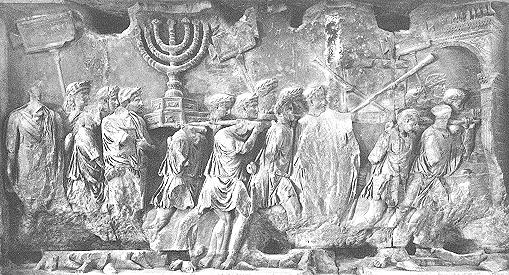
Tisha B'Av is not a good day.  The five misfortunes that led to it being declared a day of fasting include: the generation that left Egypt being sentenced by God to die wandering in the wilderness; the destruction of the first Temple by the Babylonians; the destruction of the second Temple by Rome; the defeat of the Bar Kokhba Revolt by Rome; and the razing of the Temple Mount in revenge for the Bar Kokhba Revolt.
This is what happens when people mess with Rome.  That and nearly 2 million deaths.
However, the calamities didn't end once Tisha B'Av became a fast day.  Also on the 9th of Av: the First Crusade was declared in 1095, leading to the death of 10,000 Jews in the first month; the Jews were expelled from England in 1290; the Jews were expelled from Spain in 1492; World War I broke out; and the mass deportation of Jews from the Warsaw Ghetto to Treblinka began in 1942.

However, the truly weird thing is this.  We are totally, 100% convinced that this is all our fault.  The reason the Talmud gives for the destruction of the second Temple is not, "Because that's what happens when you get into a fight with the Roman Empire."  The reason is, "Because people didn't like each other, and said mean things about each other."
This is not only a good idea; it's God's law!
On Tisha B'Av we read from the Book of Lamentations, which was written following the destruction of the first Temple.  I will summarize Lamentations for you.
1. God delivered us to our enemies, so now life is filled with humiliation, poverty, starvation, rape and cannibalism.
2. This is our own damn fault for being bad people.
3. Repent.

So that's the holiday in a nutshell.  Also, we sit around singing dirges, such as Eli Tziyon.

Sunday, August 7, 2011

Fun with Urban Legends (Part 1)

I was on the subway today when I saw a Jewish guy with a Jewish sleeve tattoo.  There is something ironic about a tattoo that says "[The Torah] is a tree of life to those who hold onto it," when the Torah also prohibits tattooing.  In any event, the sight inspired me to start a series of posts on urban legends.  These will include both false stories Jews believe, as well as false stories gentiles believe about Jews.  So without further ado, I present you with

Urban Legend #1: A person with tattoos may not be buried in a Jewish cemetery


Source: http://www.eviltattoo.com/
The way the story goes, a Jew who has a tattoo cannot be buried in a Jewish graveyard.  An exception is made for Holocaust survivors because they were tattooed against their will.  A grisly variant of the story even says that funeral homes will cut tattoos out of the skin before burial.  The recent trend of young Jews getting tattoos with religious symbolism is bringing this story back to prominence.  It is not at all obvious why anyone believes this.  Sure, tattoos are forbidden, but they are not any more forbidden than eating pork or lying under oath.  Why would violating this one commandment be so egregious that those who do it cannot be buried among their own people?

The answer, of course, is that it is total rubbish.  Interestingly, the only Jews I have heard who believe this are American.  Israelis have never even heard of such a thing, and secular Israelis often get tattoos.  One theory I have heard is that the story was told by nervous parents to stop their children from assimilating completely.  This would explain why the story doesn't exist in Israel, but it does not explain why tattoos.  Another theory is that, following the Holocaust, tattoos developed such a negative association in the older generation that the urban legend developed in order to prevent younger, more removed generations from opening old wounds.  This makes slightly more sense; when writing notes on ourselves in pen, my friends and I were frequently exhorted not to write on our forearms (hands were okay, though).  One might think, if this were the case, that the same story would also have developed in Israel.  However, geographic distance and the fact that Israelis are generally more knowledgeable about Judaism could explain this discrepancy.

For the sake of completeness, here is a summary of the rules on tattoos in Jewish law.

1.  Tattoos are forbidden.  Scarification, henna, and the like are permitted.
2.  If it is necessary to save a life or prevent death, tattoos are permitted.  Example include surgical tattoos.
3.  There is no obligation to get a tattoo removed once it has been applied.
4.  If you have one of the names of God tattooed on you, you can never be naked again.  Really.